Saturday, 28 January 2017

Its been a great start to the year.  The cold, clear days of January has meant the trees and insects have remained dormant but the bird life has been interesting and impressive.

The cold weather has brought flocks of Fieldfare and Redwing from Northern Europe, escaping from the cold and snow and looking for their favourite food - berries.  Rotherhithe doesn't have a great number of berried trees, but the few Rowans around have been closely targeted.  Not in the usual parks and woods but by the side of the road and in gardens.  A small tree on Salter Road by the busy bus stop was full of both birds, flying back up to the tops of nearby trees when alighting passenger disturbed them, then gliding back down when the coast was clear.

Fieldfare

Fieldfare


Fieldfare

Redwing


While some Redwing hang out in large groups, other shy birds prefer to forage in woodland.  A single Redwing has been hanging out near the Stave Hill entrance, quietly turning over leaf litter in the way Blackbirds do.


Redwing at Stave Hill

Redwing at Stave Hill


The local celebrity Stave Hill Firecrests have continued to show well and have attracted bird watchers from across London.  They are tiny and normally difficult to track down, but the Stave Hill birds can be particularly obliging.

Firecrest

Firecrest


Stave Hill has also had groups of Greenfinch, showy Jay, and noisy gangs of Long Tailed Tit.  Chiffchaffs have overwintered and been very active in the January sunshine.  But alas the frozen ponds have meant that the Kingfisher has been looking for food elsewhere.

Greenfinch

Jay


Long Tailed Tit

Chiffchaff


At the end of the month a Snipe arrived.  It was very difficult to see, but occasionally flew up with rapid wing beats and erratic flight before settling again in thick reeds.  No photograph but perhaps it will be tempted out when the ponds thaw.


And other birds also in roadside trees.  This very obliging Goldcreast was in a confer on Salter Road by Surrey Water

Goldcrest

Goldcrest


The docks have held large numbers of birds - mainly Tufted Duck and Black Headed Gull.  There has also been a few Common and Lesser Black Backed Gull.  The rarest visitor was a Caspian Gull seen on the sandy river bank near the Hilton, where it joined the Great Black Backed and Herring Gulls

Female and four male Tufted duck on Surrey Water

Common Gull with Black Headed Gulls on Surrey Water


Caspian Gull (photo Rich Bonser) 

Great Black Backed Gull 


So another great month for wildlife, and a reminder that in addition to out well established parks and wildlife areas, our path-side and roadside trees and small gardens can be  valuable habitats.  Conifers often shelter Goldcrest and other small birds and Rowan, Pyracantha and Cotoneaster are very attractive to visiting winter Thrushes.   No Waxwings alas but perhaps with a few more Rowan trees we may get these iconic and beautiful birds on the peninsula.


Lots to look forward to in February.  The early bulbs should push through, bees will emerge and the early breeding birds like Coots and Blackbirds will start nest building.  And hopefully the Peregrine will return to the gas holder.


Sunday, 1 January 2017

Dec 31
Its been a very mild December.  Ice has covered the ponds on Stave Hill on only a few days and this has quickly melted in the warmth of the morning sun.  So no big changes in the wildlife.  More Black-headed Gulls on the docks and river and large numbers of Tufted Ducks on Surrey Water, but only a few Shoveler in Southwark Park.

The last few days have been a little colder and a few Redwing from Scandinavia have joined the small groups of local Mistle Thrush.  A single cotoneaster tree near Surrey Water has proved particularly attractive with the bolder Mistle Thrush clacking and perching on the outer branches while the shyer Redwing favour the inside of the tree.

Mistle Thrush

Redwing


Stave Hill has again been the star place for wildlife.  The Firecrest have been very active, very vocal and (for Firecrest) very easy to see as they flit through the evergreen bushes and occasionally popping out to the path side and into willow trees.


Firecrest
Firecrest

Firecrest

Firecrest


There has been large numbers of Goldcrest too and big flocks of Long Tailed Tits moving and calling noisily through the trees.  Birds make three main types of noise.  There is the alarm call and contact call made by males and females, and then the song, which is generally only made by the male.  Robins tend to sing all winter, and they even sing at night under street lights and Blackbirds also sing in the dead of night when there are lights nearby.  Wrens also sing in the winter and were traditionally hunted on St Stephens day.  But more suprisingly Song Thrush have started to sing; obviously thinking that spring has already started and the Great spotted Woodpecker has also started to drum.  The mild weather had led to a large number of Chiffchaff deciding to overwinter in Stave Hill together with a smaller number of Blackcaps.  Chiffchaff are insect eaters and normally migrate to Africa in the winter.  But increased numbers have decided to stay and can be seen flitting through the tree tops looking for food making an occasional whooit call.  They should start to sing their unmissable song in March. A very attractive male Teal has also been dropping into Globe and Downtown ponds and a female was seen in Southwark Park.


Chiffchaff

Teal


The Kingfishers are also very active.  On one day one bird had a fish in its beak and was being noisily pursued through the tree tops by the second bird.   Strange to see them so high in the trees.

December is a good time for garden birds.  House Sparrows, once threatened, now seem to do very well on the peninsula. In the garden the next most common bird is the beautiful Goldfinch that visits the seed feeders and aggressively drives other birds off.  Magpie, Blackbird, Dunnock, Robin, Wren, Great Tit and Blue Tit are also common.  Jay, Long tailed tit and Greenfinch pass through occasionally, and lucky gardeners have visits from Great spotted Woodpecker, Goldcrest and Blackcap.

Wren

Long-tailed tit


So a very good end to an excellent year for wildlife in Rotherhithe.  Lets hope the cold snap in January brings in those Waxwings.


Wednesday, 30 November 2016

November 30 2106

It has been a lovely autumn. The trees kept their leaves well into November and the colours in Southwark Park and Stave Hill have been beautiful.  With most insects now overwintering in various stages of their lifecycle or hibernating as adults, it's the birds that are the most obvious and visible wildlife on the peninsula.

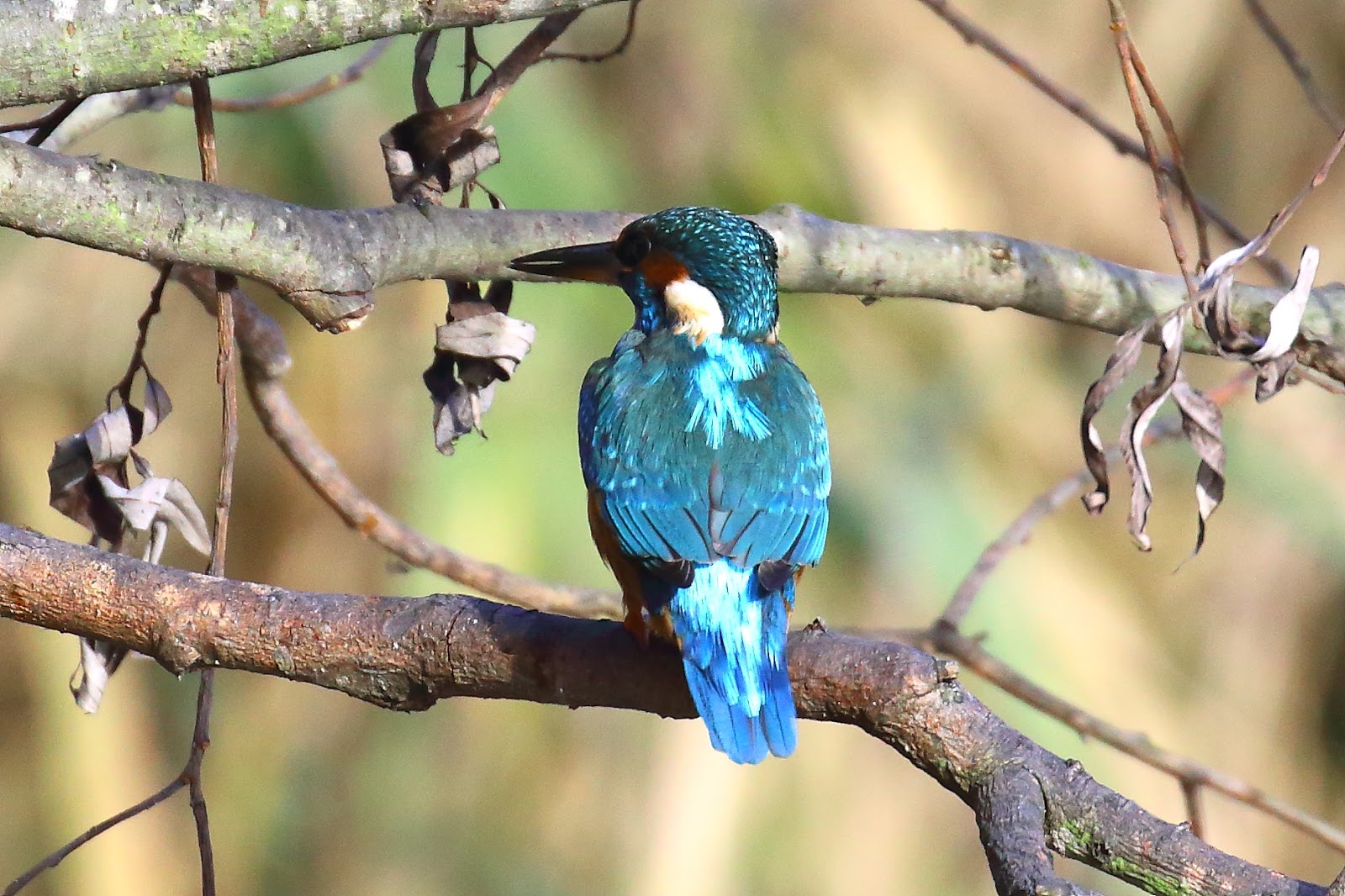
Stave Hill and Russia Dock Wooodland have held some great birds.  As the leaves fall the flocks of Long tailed Tits are becoming more visible together with large numbers of Great Tits and Blue Tits. Wrens churr from the undergrowth and Robins continue the relentless singing.  The most charismatic bird is the Kingfisher.  There are two females present.  They have favourite perches in the ponds; they are quite tolerant of noise but wary if approached.  So the normal sighting is a streak of electric blue as they fly low over the water.  When they catch a stickleback they beat it against a branch first to make it easier to swallow.

Kingfisher eying up fish

Beating Stickleback against branch


Swallowing hard

Showing off plumage


Rarer than the Kingfisher, harder to see and even harder to photo is the tiny Firecrest.  Two birds were present in November flitting restlessly through the bushes and trees near the main entrance to the Eco Park.  They have arrived for the winter and will hopefully stay until March.  They are really special birds for Rotherhithe; very similar to the more familiar Goldcrest but with bold black and white eye stripes. Stave Hill must be one of the best places in the country to get close views of this scarce and beautiful tiny bird. 

Firecrest in Stave Hill

Firecrest
There were two other special winter visitors to Stave Hill.  A very attractive male Teal - a genuinely wild duck - on Downtown Pond, and a Fieldfare - a visitor from Scandinavia - on the highest bit of woodland feeding on berries.  Greenfinch and Chaffinch have also arrived in good numbers and are becoming much easier to see as the trees lose their leaves. 

Male Teal

Fieldfare


Chaffinch

Greenfinch


On the docks, Tufted Duck and  Black headed Gulls are the most common birds.  Its a difficult time for Swans with adults driving young from their territory.  The pair on Surrey Dock didn't fare too well this year.  Only one cygnet survived and it appears that it can't fly.  The Swan Sanctuary has been monitoring Surrey Water and is concerned that the male Sawn may chase off the cygnet before he is mature enough to cope on his own.  They are asking to be alerted of signs of aggression from an adult.  Their website is http://www.theswansanctuary.org.uk.  The contact number is 079780 404 866


Surrey Water is not a great territory for Swans with very little in the way of vegetation for them to feed on.  Their main diet is bread thrown in by local families.  There is nothing wrong with bread; it doesn't harm the Swans, but it probably needs to be part of a wider diet.  Another adult Swan did drop into Surrey Water early in the month, but was seen off in a fairly brutal way by one of the locals. 

Local Swans drive off  newcomer


In Southwark Park the attractive and well named Shovelers have arrived in good numbers and a flock of 40 Redwing flew over early in the month.  Also three Little Grebe have been present

Male Shoveler

Little Grebe


So another great month of wildlife.  As the weather get colder we should get more winter visitors; certainly Redwing and hopefully Waxwings feeding on berries.  And perhaps the Peregrine will return to its perch on the Surrey Water gasholder. 


Monday, 31 October 2016

Sunday October 30  2016
In the mild, dry autumn the trees have held their leaves well and the peninsula is beginning to turn golden and red.   There are still plenty of insects and spectacular amounts of fruits to feed the passage and winter resident birds.  The docks have filled with winter ducks and gulls as the wonderful ebb and flow of wildlife in Rotherhithe continues. 

The star bird of the month has been the Kingfisher on the stream and ponds in Russia Dock Woodland.  Its favourite perch is the dead branch on the left side of Downtown Pond.  But you have to approach very carefully from behind the reeds to avoid putting it to flight.  On the last day of the month a second Kingfisher was seen.  If it is a pair,  they are unlikely to stay into the summer and breed. There are no suitable nest sites and too many predators, but lets hope they stay and entertain us until Spring.  Obviously, despite some problems with the water there are still sufficient small fish to keep the Kingfishers well fed, and also the Grey Heron that has taken up residence.  There are still plenty of small insects and the Chiffchaffs were still present at the end of the month and actually singing on 31 October.  They normally migrate back to Africa, but a small number over winter if there is sufficient food.  Plenty of Goldcrest have arrived and a Firecrest was seen on 23 October.  The fruiting trees are attracting large numbers of Goldfinch and Blackbird and a few Mistle and Song Thrush. The most common sounds in the woods are the chattering Wrens and singing Robins as they establish winter territories, and of course the harsh call of the Ring Necked Parakeets. 

Kingfisher on Downtown Pond

Kingfisher on Downtown Pond


Wild Rose hips

Late singing Chiffchaff

Goldcrest


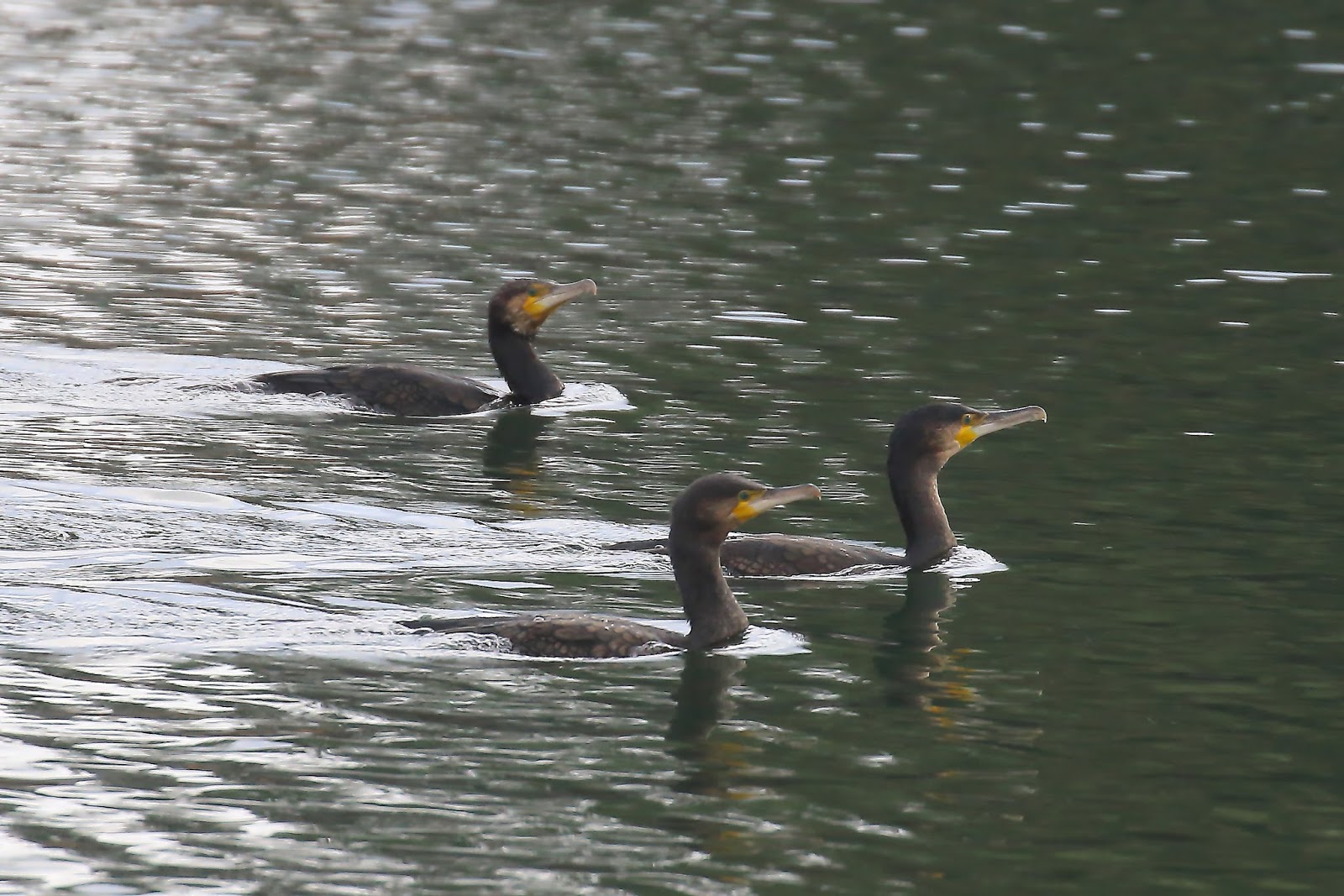
In the docks the Tufted ducks have returned in large numbers; over 100 on Canada water and 50 on Surrey Water.  Black-headed Gulls have also returned in large numbers together with the odd Lesser black-backed and the not so common and rather elegant Common Gull.  Territorial squabbles have started with the Coot fights being particularly feisty.  The Adult Swans also try to drive the juveniles away; this causes real problems if the juvenile can't fly and on a number of occasions the Water Wardens have been called into action to move them to safety.  There are good numbers of Cormorants too on Canada Water often fishing in groups for Perch.  Another sure sign of good water quality despite the fall in level.

Common Gull with Black-headed in background

Coot fight


Fleet of Cormorants fishing for Perch in Canada Water


Shovelers have also returned to Southwark Park.  These are very attractive ducks the breed on the Essex or Kent marshlands.  In the winter these birds move south and there is an influx of migrants from the continent.  They feed on mollusc and invertebrates so obviously Southwark Park boating lake is in a healthy shape.  A nice pair of Little Grebe have also been showing well and Cormorants have been using convenient perches in the boating lake.

Male Shoveler

Cormorants on the boating lake


0


Little Grebe


As the leaves fall in November the birds will become easier to see.  So watch out for the Kingfishers, Great spotted Woodpeckers and Jays.   Perhaps some winter thrush will arrive from Scandinavia and maybe the fruiting bushes will even attract some exotic Waxwings.